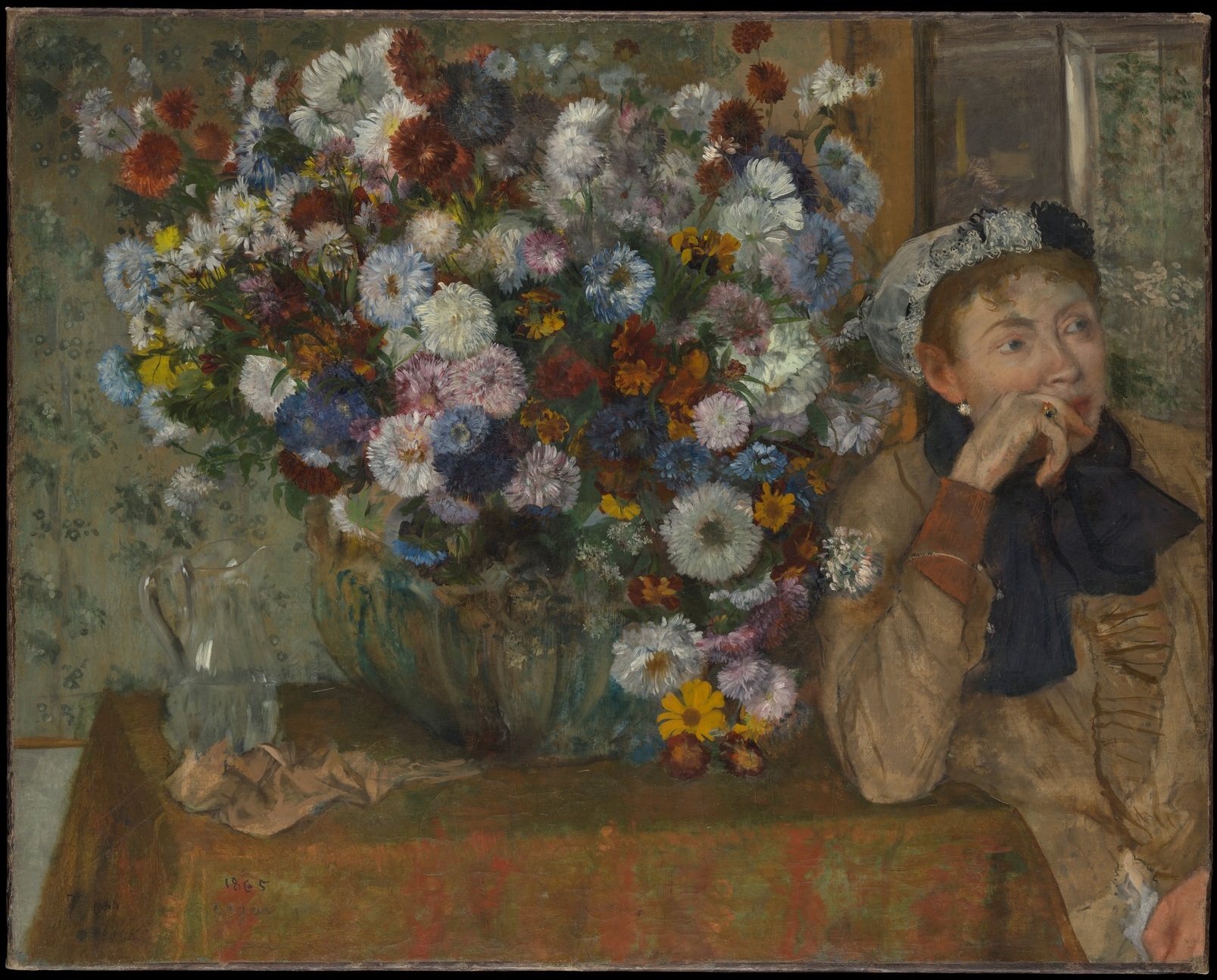
A Woman Seated beside a Vase of Flowers (Madame Paul Valpinçon?)
A viewer’s eye is immediately drawn to the explosion of color on the left side of Edgar Degas’s painting, "A Woman Seated beside a Vase of Flowers (Madame Paul Valpinçon?)" (1865). The abundant bouquet fills nearly half of the canvas, presenting a dense arrangement of blossoms in purples, pinks, reds, and cream tones. Degas applied vibrant, broken brushwork to the flowers, imparting an energetic, spontaneous quality to the petals and leaves—a striking visual contrast to the quieter presence of the woman who occupies the right of the composition.
The juxtaposition between the luxuriant vase of flowers and the calm, contemplative figure establishes the focus of the painting. The woman, dressed in a pale, ruffled dress with a dark bow at her neck, leans on a table in a relaxed, inward-facing pose. Her head is angled toward the flowers, but her gaze is averted downward, not fixed on the blooms. This subtle disconnect conveys a sense of private reflection. Degas painted her features with more smoothly modulated, tender brushwork than the vigorous strokes describing the flowers, emphasizing the contrast between stillness and vitality within the scene.
An elaborate interior setting further enriches the composition. The background is covered with a pattern that evokes floral wallpaper, in subdued shades of blue, pink, and beige. These gently alternating colors echo the vibrancy of the central bouquet but are rendered with a more reserved, stylized approach. The dialogue between the wallpaper’s flat, decorative pattern and the textured mass of living flowers heightens the interplay between artifice and realism, a recurring interest in Degas’s work.
On the table before the woman, Degas includes a transparent glass pitcher and a casually draped white cloth. The pitcher exhibits careful attention to how glass refracts and transmits light: reflections, distortions, and the visible table edge become elements in an understated technical display. The white cloth, with its creases and folds, introduces a further dimension of physicality and informal domesticity to the arrangement. Together, these details root the scene firmly in a middle-class nineteenth-century French household.
Degas dated the painting to 1865 on its upper edge, situating it in a period when he explored the possibilities of intimate interior genre scenes. According to the Metropolitan Museum of Art—the current holder of the work—the figure may depict Madame Paul Valpinçon, an acquaintance of Degas and member of a family frequently portrayed by the artist. However, her identification remains uncertain. This ambiguity directs focus away from individual biography toward the general atmosphere of introspection and stillness that Degas cultivated through his handling of pose, gesture, and setting.
The technique on display hints at Degas’s evolving pictorial interests. He contrasts energetic, visible brushwork in the flowers with precise, smoother modeling in the human form. The overall structure divides the canvas diagonally between bouquet and figure; this dynamic organization sets up a tension between liveliness and composure, with neither side overwhelming the other. Such compositional strategies anticipate the experimentation seen in Degas’s later works, where he increasingly privileged subjective experience and visual sensation over traditional symmetry.
Interpretation of the woman’s mood is ultimately speculative, rooted in observations about pose, gesture, and compositional relationships. What is visually evident is Degas’s juxtaposition of flourishing, transient nature with human quiet and reserve. The painting’s effect arises from this interplay: an exuberant, tactile celebration of color and texture on one side, and a nuanced, contemplative evocation of inner life on the other. In this blend, Degas demonstrates his acute sensitivity to both the material and psychological dimensions of everyday domestic experience.
About the artist
Edgar Degas (French, Paris 1834–1917 Paris) was a prominent nineteenth-century artist, renowned for his innovative approaches to painting and drawing. His work often focused on scenes of modern Parisian life, characterized by acute observation of form, light, and gesture. 'A Woman Seated beside a Vase of Flowers (Madame Paul Valpinçon?)' exemplifies Degas's interest in depicting private moments and the textures of contemporary interiors, foregrounding his experimentation with composition and varied brushwork.
Edgar Degas, Self-Portrait, by 1857. The young artist turns his head slightly, with one side of his face in shadow. The Metropolitan Museum of Art · Bequest of Walter C. Baker, 1971
Read the painting details
A season in the vase
The dahlias and asters crowd out almost everything behind them. For the Met, these flowers are a clue to the season: Degas may have seen them on a late-summer visit to his friends’ country house at Ménil-Hubert.
A pose caught twice
With her hand at her mouth, the woman looks toward something beyond the right edge. It feels like a moment you might miss, yet Degas had already drawn her in pencil in 1865, the same year he painted her here.
One table, two subjects
A clear glass jug stands beside a loose cloth at the left end of the table. Follow the tabletop to the other end, where the woman props her elbow: the same piece of furniture holds a still life at one end and supports a portrait at the other.