Young Woman with a Water Pitcher
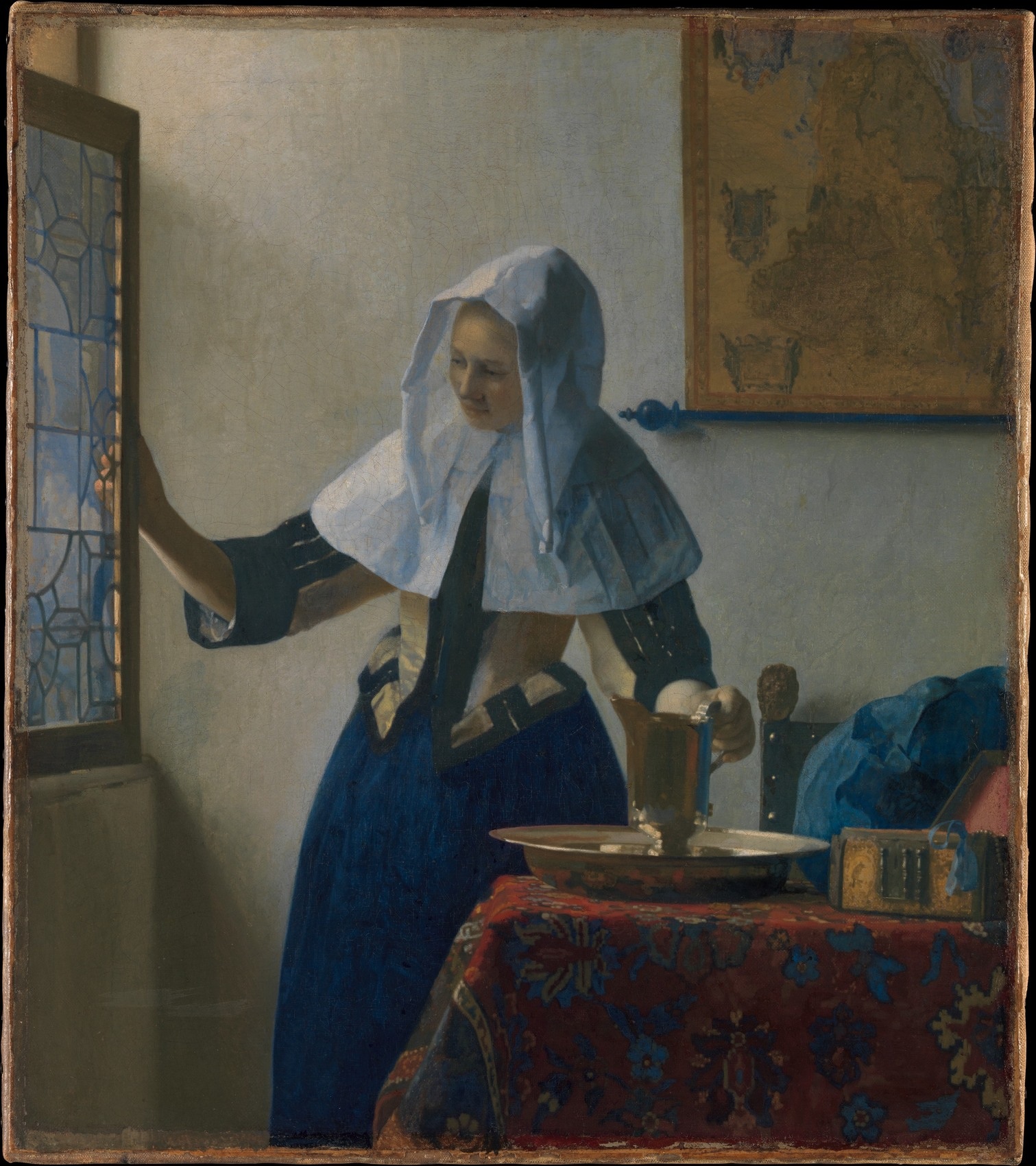
A prominent luminous detail in Johannes Vermeer’s "Young Woman with a Water Pitcher" is the stained-glass window to the left of the composition. Rendered with clear geometric panes separated by metal cames, the window allows gentle sunlight to filter into the simple Dutch interior. The incoming light softly illuminates the woman's white linen cap and the contours of her face and hands. Vermeer masterfully creates the illusion that the ambient daylight is tangible—his hallmark sensitivity to nuances of natural light is on full display here.
This handling of light is integral to the work’s atmosphere. Painted around 1662, the oil-on-canvas measures 18 by 16 inches (45.7 x 40.6 cm). Despite its modest size, Vermeer achieves a sense of expansive depth and airiness. The precise segments of the window firmly situate the woman within her domestic setting and guide the viewer’s attention throughout the composition, from the highlights on the objects to the gentle modeling of forms.
The young woman is positioned at the center, dressed in a blue bodice and with a white veil falling along her shoulders. Sunlight catches on her starched linen and softly shapes her profile, with the brightest accents on the cap, collar, and extended hand. The subtle gradations from light to shadow reveal Vermeer’s command of tonal modulation, conveying both the serenity and the underlying structure of the figure as she pauses with the silver pitcher held above a matching basin.
The tabletop, covered in an elaborate red and gold carpet, showcases Vermeer’s attention to detail. The intricate patterning of the table covering is accomplished with careful brushwork, standing in contrast to the reflective smoothness of the silver pitcher and basin placed atop. A small jewelry box sits nearby, its lid delicately open, suggesting the routine of daily life. The inclusion of a blue cloth draped over the adjacent chair introduces another layer of color harmony, integrating the painting’s rich, balanced palette.
On the wall, a large map rendered in subdued, earthy hues provides a further glimpse into the cultural world of 17th-century Dutch interiors. Maps were common decorative elements in homes of the Dutch Republic, often signifying education or global awareness. Vermeer’s precise depiction of the map adds historical specificity to the composition, and its faded surface forms a visual counterpart to the foreground’s tangible textures without overt narrative.
Technical mastery is evident in Vermeer’s depiction of optical effects. On the surface of the silver pitcher, highlights and subtle reflections echo the shape of the window and suggest keen observational prowess. Slight blurring at the edges and the interplay between crisp detail and atmospheric diffusion evoke the gentle transitions of light he is celebrated for, whether or not optical aids were used. The Metropolitan Museum of Art describes Vermeer’s remarkable ability to manipulate both perspective and illumination, and the painting demonstrates these strengths.
Scholarly commentary commonly notes the introspective quietness that suffuses the scene. While the precise meaning remains open—potentially inviting interpretations around domestic devotion or contemplation—the museum’s record emphasizes Vermeer’s descriptive fidelity and focus on the visual qualities of everyday materials. No explicit symbolic reading is confirmed in the museum documentation; rather, the painting offers a study in the balance of light, color, and compositional restraint.
"Young Woman with a Water Pitcher" was produced during Vermeer’s Delft period and remains a quintessential example of his mature style. The serenity, clarity, and spatial coherence achieved through poised figure placement and refined color harmonies continue to invite attention, reflecting Vermeer’s enduring ability to reimagine the simple rituals of daily life as moments of contemplative beauty.
About the artist
Johannes Vermeer (Dutch, Delft 1632–1675 Delft) was a leading painter of the Dutch Golden Age, celebrated for his luminous domestic interiors and subtle treatment of light. His 'Young Woman with a Water Pitcher' exemplifies his mastery in depicting refined spaces and atmospheric effects. This painting is held in the Marquand Collection at The Metropolitan Museum of Art.
From Vermeer’s work: The Milkmaid, c. 1660. Here the liquid is already flowing, in contrast to the poised pitcher in the Met painting. Rijksmuseum, Amsterdam
Read the painting details
One hand on the window
The woman reaches across to the open window while her other hand rests on the pitcher. In this Delft interior, painted around 1662, the two hands let us catch her between actions, with daylight already falling across the basin.
Dressed for washing
The white linen that frames her lowered face spreads over her shoulders. Those coverings had a job to do: they protected her hair and clothes while she washed, a small practical detail that explains why she is dressed this way indoors.
Before the pour
Her fingers curl around the handle, but the gilt silver pitcher is still upright in its basin. Vermeer gives us the instant before water might flow: the brightest glint belongs to the metal rim, and her hand has barely disturbed it.
A room with two views
The map hangs high enough for its lower edge to run just behind the woman’s head. There are two ways to see beyond this room: she can turn toward the real window, while the viewer can study a piece of the world on the wall.
The occupied chair
A fold of deep blue cloth spills over the chair at the far right. Imagine taking a seat there: the table and its patterned cover would be between you and the woman, who carries on with her morning without looking up.