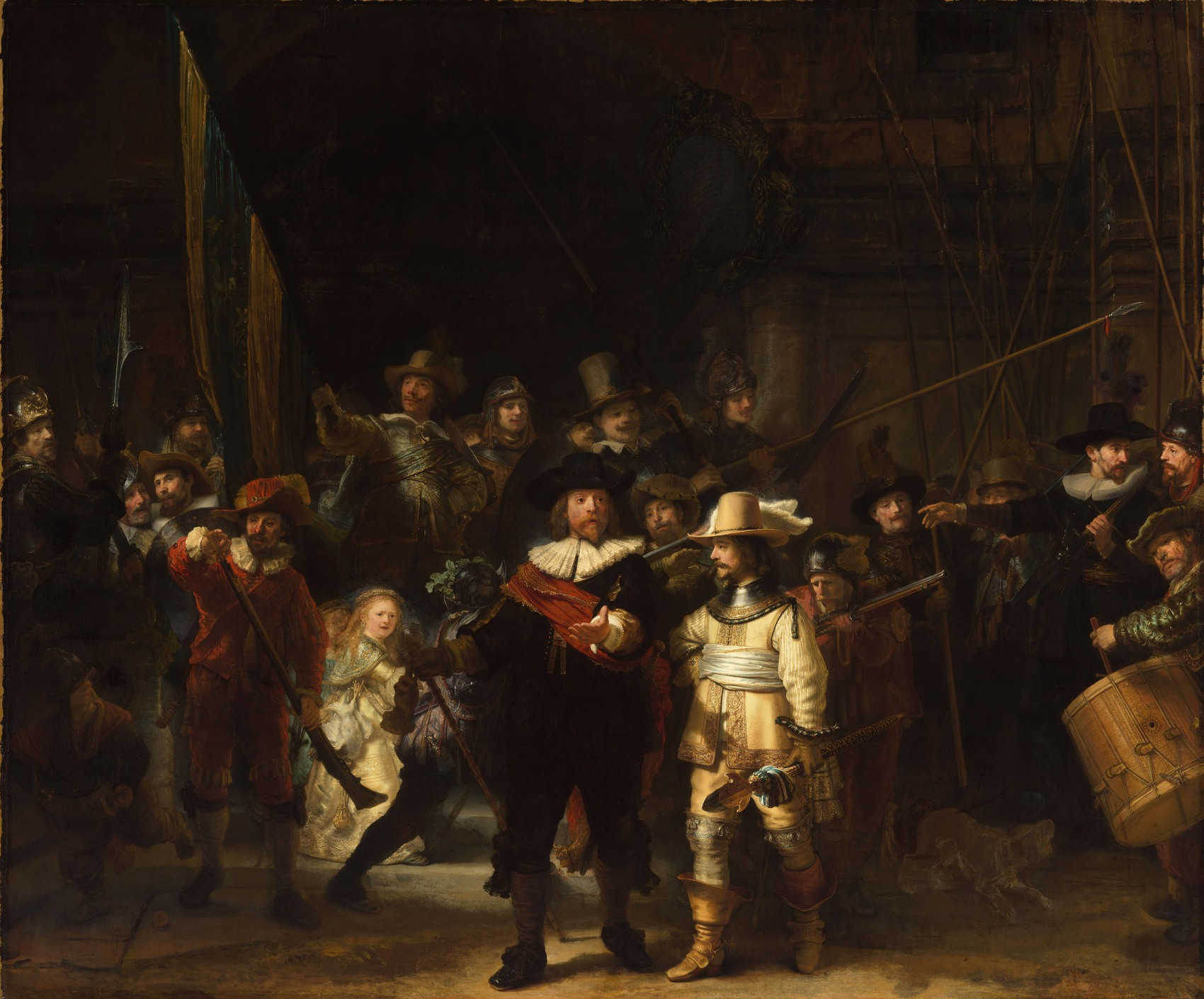
The Night Watch Militia Company of District II under the Command of Captain Frans Banninck Cocq
Look for the captain’s fingers twice. First they reach out from a white cuff, palm up, against the red sash of the man in black. Then, a little lower and to the right, their shadow falls across the pale yellow coat of the officer beside him. The two men advance almost shoulder to shoulder, but the shadow lets you see how far the hand projects in front of the coat. It also makes a connection you can follow without knowing either man’s name.
Their names mattered in the room where this picture first hung. In 1642 Rembrandt painted it for the great hall of the Kloveniersdoelen, headquarters of Amsterdam’s arquebusiers, one branch of the civic guard. These men served as the city’s militia and police. The commission came from or on behalf of the sitters. In their own hall, a visitor could have looked up at this canvas, more than four and a half metres wide, and picked out a familiar face. Follow the captain’s hand instead, and the portrait becomes an account of how these people act together.
The hand belongs to Captain Frans Banninck Cocq. The Rijksmuseum reads his gesture as an order to Lieutenant Willem van Ruytenburch, the officer in yellow, to start the company marching. Notice how little the captain has to move. His elbow stays close to his side. It is the reach of the fingers, not a sweeping arm, that carries the order, and the brightest stretch of cloth in the foreground receives their shadow. The lieutenant looks toward the captain. Behind him, hardly anyone looks in quite the same direction.
That scattering of attention is what makes the order convincing. A man in red bends over his musket on the left. Above him the standard rises nearly to the top of the canvas. At the opposite edge a drummer lifts a stick; down by the drum a dog barks. The two officers have stepped clear of the crowd, but farther back it takes some looking to work out which arm belongs to whom. The company is still getting into formation. Had the men already lined up and turned to face us, we could inspect them one by one, but there would be very little left for the captain’s hand to do.
Light doesn’t simply pick out the officers in order of rank. Follow the yellow of the lieutenant’s coat back into the crowd and you find a small girl, her face more clearly lit than those of several men around her. A dead chicken hangs at her waist. The Rijksmuseum identifies her as the company mascot. Men hem her in on every side, yet she is among the easiest figures to find. One of the most conspicuous figures in this portrait of guardsmen represents the company without being a guardsman.
High beside the gateway, a shield carries a list of names. It begins with the captain and lieutenant, much as a record made in 1653 identifies the painting in the hall by its two officers. The familiar nickname, *The Night Watch*, came into use only in the late eighteenth century. On the shield the men keep their places, and you can read the company in order from top to bottom. Down below, Rembrandt gives it another order, harder to hold still: a palm turns up, its shadow touches a coat, and the march is about to begin.
About the artist
Rembrandt van Rijn painted *The Night Watch*, his largest canvas, in Amsterdam. Two of his group portraits in the Rijksmuseum show different sides of civic life there: the guardsmen of District II in 1642 and, twenty years later, the sampling officials of the city’s drapers’ guild in *The Syndics*.
Rembrandt van Rijn, Self-Portrait, c. 1628. A strip of light catches his cheek while his eyes sit in shadow. Rijksmuseum, Amsterdam
Read the painting details
The standard-bearer
The raised flag hangs in long folds of yellow and green against the dark gateway. The inscription names the officer who carried the company standard: Jan Visscher Cornelisen, listed just after the lieutenant and before the two sergeants.
Sources · Rijksmuseum collection record
Eighteen names
The shield beside the gateway bears eighteen names. Its wording does more than identify faces: before giving Willem van Ruytenburch’s rank as lieutenant, it calls him lord of Vlaerdingen. The list preserves his title as well as his place in the guard.
Sources · Rijksmuseum collection record
Upturned claws
The girl in pale gold carries the chicken upside down, its claws pointing up against her embroidered clothes. Its white feathers nearly merge with her skirt; the dark curve of a musket stock passes in front of both.
The captain in the inscription
The outstretched hand belongs to a man whose name takes a different form on the shield. The museum title calls him Frans Banninck Cocq; the painted inscription gives “Frans Banning Cocq” and identifies him as lord of Purmerlant and Ilpendam.
Sources · Rijksmuseum collection record
The lieutenant in the record
The officer in pale yellow appears in the 1653 record as “Witt van Ruijtenburg Lut.” Even in that abbreviated entry there is room for the painter’s name and the date of the work, 1642.
Sources · Rijksmuseum object page
More than muskets
The helmeted man behind the lieutenant holds his musket diagonally across his upper chest, below his chin. The catalogue identifies pikes and halberds as well as muskets among the company’s weapons. Look above his helmet and their long shafts stand out against the wall.
Sources · Rijksmuseum collection record