Vale of Kashmir
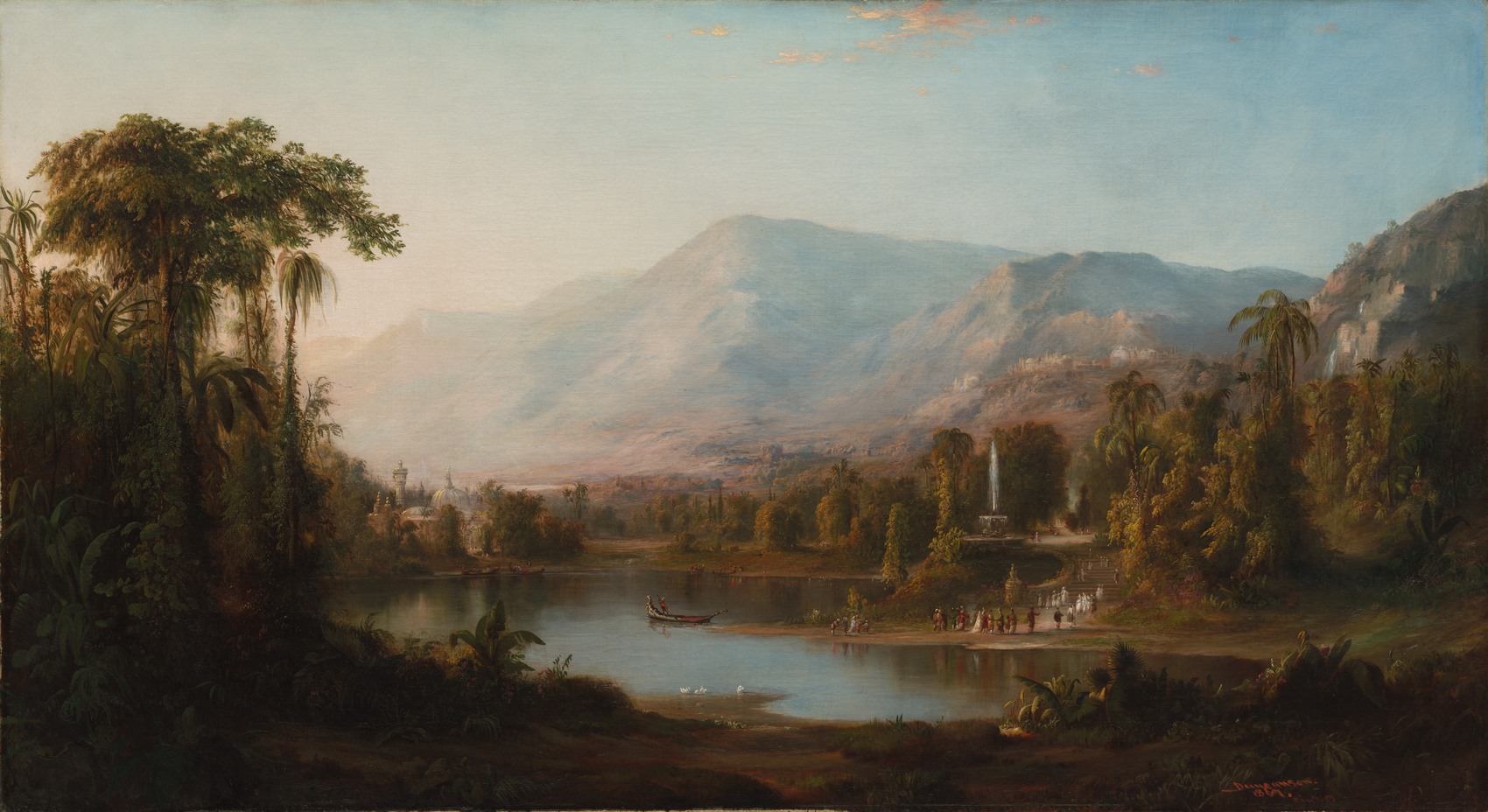
A narrow boat points toward a strip of shore near the center of Robert S. Duncanson’s Vale of Kashmir. It is small enough to miss at first, a dark curve against the water. Follow its course to the right and a gathering of red, white and gold figures comes into view. Beyond them, more figures climb a broad staircase toward a fountain.
The Cleveland Museum of Art describes the people as a courtly entourage, traveling from a palace at the left of the lake to a plaza above the shore. Duncanson gives their journey several stages, but not much room. The boat occupies a sliver of the canvas; the procession is a line of tiny marks. Around them, trees frame a valley that opens onto immense, hazy mountains.
The painting takes its subject from Lalla-Rookh, an epic poem published in 1817 by Thomas Moore. Its story follows a Persian princess traveling to the Indian subcontinent to be married. The poem was popular when Duncanson painted this canvas in 1867, and the museum identifies an episode in it as his inspiration. The picture does not require us to recognize every traveler, however. It offers enough activity to suggest a story while allowing the landscape to carry much of the experience.
Look back across the lake from the boat. Pale domes and a slender tower appear among the trees on the left bank. The museum calls this a quasi-Islamic palace, the starting point for the entourage in Duncanson’s conception. It is partly screened by foliage rather than presented as a theatrical backdrop. On the opposite bank, the fountain’s white spray is easier to pick out: a vertical flash amid dark trees, above the route of the people below.
These landmarks let the eye travel without turning the canvas into a map. The boat, shore and stairs make a sequence, but distance separates each part. The procession seems at once purposeful and very small. The museum observes that the human elements are subordinate to the landscape’s splendor; looking at the broad mountains behind them, it is easy to see how Duncanson achieved that difference in scale.
The canvas measures 73 by 132.4 centimeters unframed. Duncanson uses its width to keep several kinds of space in view at once. Dark plants press close along the lower edge, the lake lies beyond them, and the distant slopes dissolve into blue-gray and pink. A viewer can trace the procession from left to right, then move upward into terrain that seems to extend far beyond it.
Even the water offers more than one route through the picture. The boat lies just off a projecting shore, while the lake curves away into the foreground. Its broad, quiet surface separates the travelers from the dense plants nearest us. The spray of the fountain, by contrast, catches the eye well above their heads.
There is another distance to keep in mind. Duncanson was a Cincinnati-based African American artist working in a country transformed by the Civil War. During the war he relocated to Montreal, where, according to the museum, he inspired several Canadian landscape painters. Vale of Kashmir dates from 1867, after the war. The museum’s account does not establish that the painting illustrates his wartime experience, and its literary subject should not be treated as a coded autobiography.
Its circumstances nevertheless matter. The museum identifies Duncanson as the first African American artist to achieve recognition nationally and abroad. His career crossed borders during a period of national upheaval; this painting, meanwhile, turns to a popular literary journey and gives it the breadth of a panorama. That combination is a fact of the work’s history, not proof of a hidden message.
At the shore, the little boat still holds its place between the palace and the figures on the shore. It gives the vast scene a direction. Yet the farther the eye follows the travelers, the more the painting opens around them: their route is only one small passage through the valley.
About the artist
Robert S. Duncanson (1821–1872) was an American landscape painter based in Cincinnati. During the Civil War he relocated to Montreal, where he influenced Canadian landscape painters. The Cleveland Museum of Art acquired Vale of Kashmir in 2014.
From Duncanson’s work: Waterfall on Mont-Morency, 1864. Here he turns to a named site near Québec. Smithsonian American Art Museum · Gift of Dr. Norbert Fleisig
Read the painting details
A palace in the trees
The pale domes belong to what the Cleveland Museum of Art calls a quasi-Islamic palace. Trees conceal much of the complex, leaving its light-colored architecture to emerge in fragments rather than as one continuous façade.
Landing place
The boat’s dark hull sits just off a low strip of land. The museum identifies the shore as the entourage’s arrival point; the image does not clearly show the moment when the boat makes contact.
A literary journey
The colorful figures form part of a courtly entourage. The museum connects the painting to Thomas Moore’s Lalla-Rookh, an 1817 epic about a Persian princess’s journey to the Indian subcontinent for her marriage. It does not identify an individual figure here as the princess.
Steps to the plaza
The broad staircase carries the procession upward from the shoreline. Its pale horizontal bands make the route visible even where the figures are tiny. The museum identifies the destination above as a plaza.
Water in the air
The fountain’s bright spray rises in a narrow vertical line against the dark trees. Its slim shape contrasts with the wide, horizontal lake below; a small pale base anchors the plume to the ground.
Landscape at scale
The hazy mountain range stretches across much of a canvas nearly twice as wide as it is tall. The museum counts this panoramic painting among Duncanson’s grandest, while noting that its people remain subordinate to the landscape.