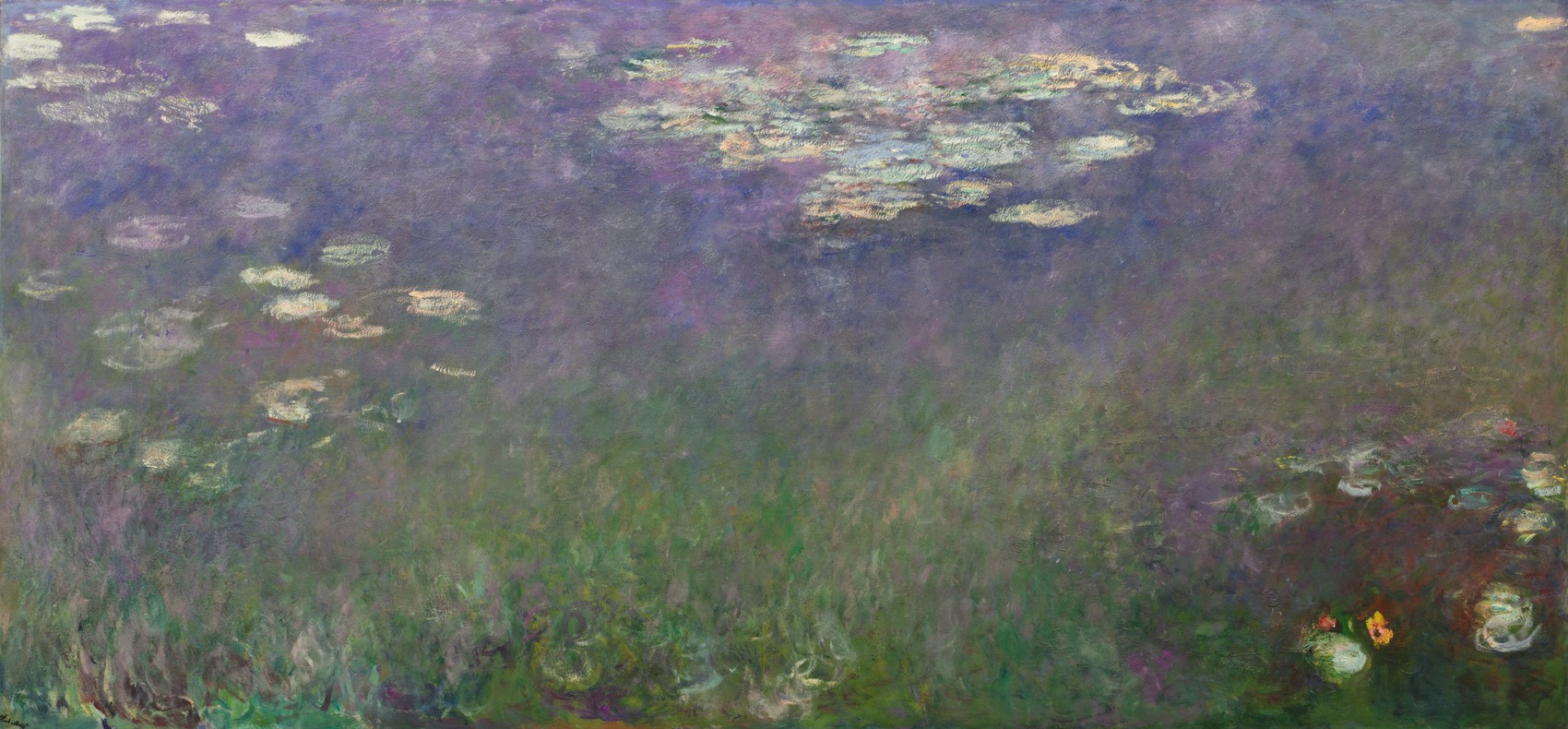
Water Lilies (Agapanthus)
At the lower edge of the pond, green strokes push upward through violet and gray. Some are narrow and upright; others dissolve into the dark around them. They do not quite settle into a neat row of plants. Above them, pale lily pads lie flatter, their short horizontal marks floating against a surface that seems to have both depth and shine.
Claude Monet knew this pond as more than a passing visitor. At Giverny, in northern France, he designed and helped cultivate the private garden that became the subject of paintings throughout his last 30 years. In Water Lilies (Agapanthus), dated around 1915–26, the garden is not presented as a place to stroll through. Monet leaves out the paths and banks that might tell us where to stand. The vegetation at the bottom gives us something to grasp, then yields to water.
That shift makes the painting difficult to measure by ordinary landscape conventions. There is no horizon to separate water from sky, and no shore to establish a distance. The Cleveland Museum of Art describes the result as a suggestion of limitless expanse, strengthened by the canvas’s great horizontal width. That is a curatorial reading of a choice visible in the work: the pond reaches every edge, while the familiar boundaries remain outside the frame.
The pale marks at left are scattered and individually legible. Higher up, a larger cluster gathers cream, yellow and green strokes into an irregular band. Between these groups, violet and green spread across an open interval. The eye can travel from one cluster to the next, but it must also spend time in the less clearly named space between them.
The museum describes the painting as attending to momentary sunlight, both penetrating the water and reflecting from its surface. The two effects are not easily separated here. A light stroke can read as a pad, a reflection or a patch of glare; the dark green below can feel like vegetation under water or color on its surface. That uncertainty is a possible way of experiencing the picture, not a statement Monet left about it.
The sustained access behind this view came after a career marked by less secure circumstances. In 1861, Monet was drafted for military service. His family would pay for his release only if he gave up painting; he refused that condition and served in Algeria before illness brought an early return to France. Later, creditors forced him to leave Paris. In 1870, he went to London to escape the Franco-Prussian War.
These earlier pressures do not explain a particular stroke in the pond painting. They do show how hard-won a life in painting could be before Giverny became his lasting home. According to the museum’s account, Monet helped organize the First Impressionist Exhibition of 1874 partly because the dealer Durand-Ruel’s worsening business situation had prevented him from buying Monet’s work. In those years, Monet also converted a boat into a studio, giving himself different viewpoints for his landscapes.
By the time of this canvas, Monet was working on a scale far beyond the small group of strokes with which we began. In his final years he also made the Great Decorations, large pond paintings designed for two oval rooms at the Paris Orangerie. The Cleveland painting should not simply be assumed to belong to that installation. It shares, however, a late preoccupation with making water occupy a large visual field. Look back at those green strokes: they anchor the picture without supplying the solid ground that a conventional landscape might promise.
About the artist
Claude Monet (1840–1926) was a French painter and an organizer of the first Impressionist exhibition. He was living at Giverny by 1883 and returned repeatedly to his garden and pond in the paintings of his later years.
Auguste Renoir, Claude Monet, 1872. Renoir shows the painter looking down at a book, with a pipe in his hand. National Gallery of Art, Washington · Collection of Mr. and Mrs. Paul Mellon
Read the painting details
A garden made over time
Green vegetation: Monet was living at Giverny by 1883 and remained there for the rest of his life. The garden was both a cultivated place and a continuing source of subjects; the museum notes that his garden paintings vary considerably in motif, format and size.
Sources · The Cleveland Museum of Art object page
A subject revisited
Left-hand lily pads: These pale, broken marks belong to a subject Monet returned to again and again. The museum estimates that he made around 250 water-lily compositions, a body of work rather than a single fixed view.
Sources · The Cleveland Museum of Art object page
Light on and in water
Bright upper lily cluster: Cream and yellow marks sit among cooler greens and violets. The museum identifies sunlight penetrating and reflecting from the pond as a focus of the painting, giving these light accents more than one possible visual role.
Sources · The Cleveland Museum of Art object page
A pond without edges
Open water: This interval separates the clusters without offering a bank or horizon as a reference point. The museum argues that their omission helps suggest a limitless expanse; the frame cuts the water off without appearing to contain it.
Sources · The Cleveland Museum of Art object page
The reach of the canvas
Violet water at upper right: The color continues toward an edge more than four meters from the painting’s left side. Unframed, the canvas measures 201.3 by 425.6 centimeters, so its width is a physical fact as well as a compositional effect.
Sources · The Cleveland Museum of Art object page
From Giverny to Cleveland
Flowers at lower right: These accents belong to a canvas dated around 1915–26, when Monet also worked on his Orangerie decorations. After the artist’s estate, Michel Monet held the painting through 1950, according to Connaissance des arts (1966); Katia Granoff and Knoedler & Co. followed before the museum acquired it.