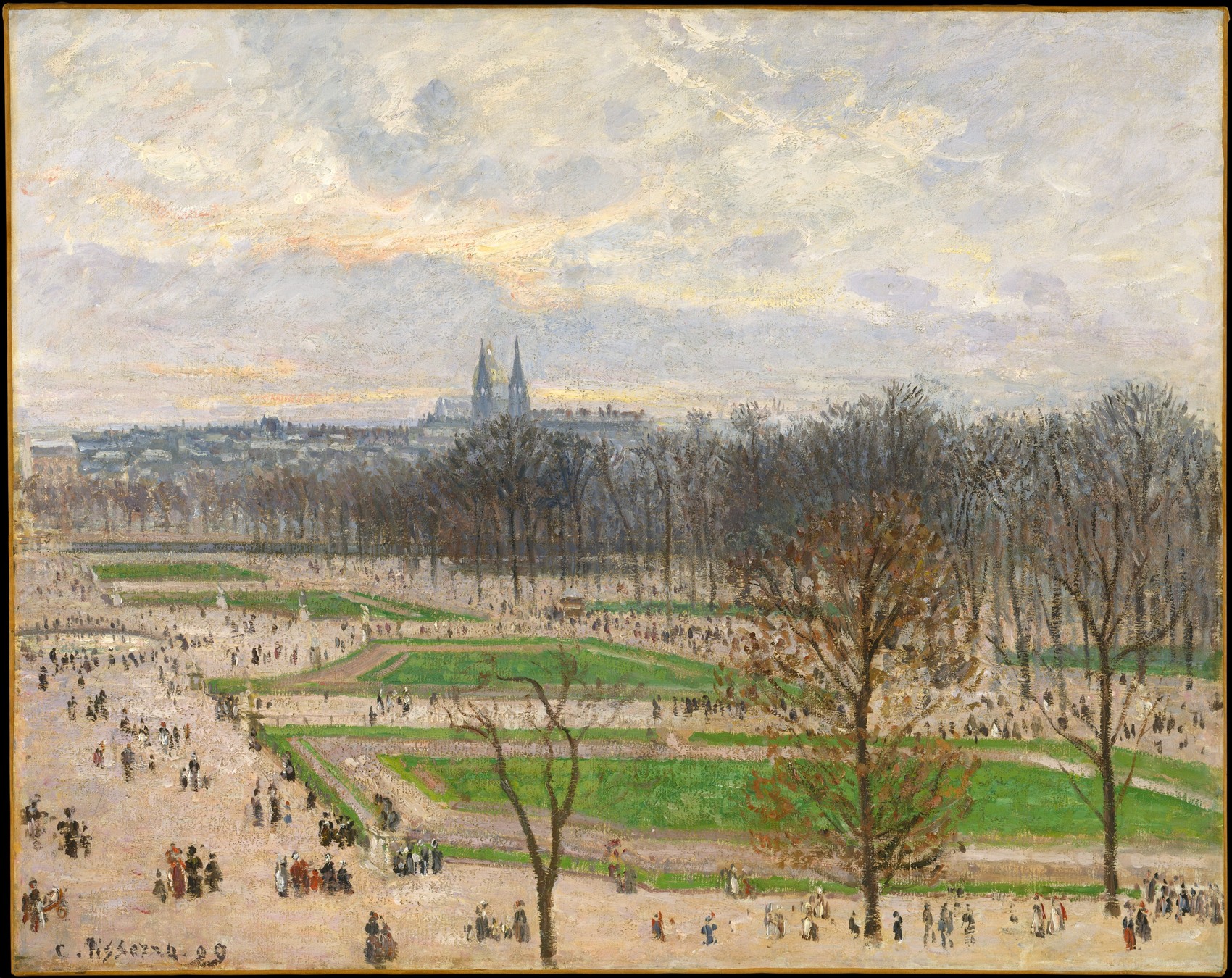
The Garden of the Tuileries on a Winter Afternoon
At the lower left corner of Camille Pissarro’s “The Garden of the Tuileries on a Winter Afternoon,” small groups of figures cluster along winding paths. These dark silhouettes stand out against the pale gravel and muted greens, creating lively punctuation in an otherwise subdued winter scene. The figures are painted with abbreviated brushstrokes, each group seemingly engaged in afternoon strolls or conversation, evoking social activity with minimal detail—typical of Pissarro’s skill in alluding to urban life through gestural painting. Their presence introduces movement and warmth to the landscape dominated by a wintry palette.
Pissarro constructs the composition with a careful sense of spatial order. The viewer’s eye travels from the foreground paths and lawns—arranged in rectilinear and curving configurations—up toward a linear band of leafless trees that crosses the picture horizontally. This dark, intricate mass divides the cultivated garden from the atmospheric gray of the Parisian cityscape beyond. The skyline recedes into the soft haze of a winter afternoon, its outlines blurred and subtly modulated, reinforcing the Impressionist interest in transient effects of light and weather. The balance between horizontal and diagonal elements orchestrates the painting’s panoramic sweep.
Foreground trees at the right edge are painted with spindly, slightly arching branches and sparse, lingering autumn leaves near the tips. Against the lighter lawns and gravel, their form provides a striking visual contrast in both color and texture. Pissarro’s brisk, sketch-like brushwork here underscores the spare, transitory appearance of foliage in winter. The trees’ delicate silhouettes, rendered with layered brushstrokes, exemplify the Impressionist goal of capturing seasonal atmosphere and the fleeting passage of time.
Throughout the canvas, Pissarro employs varied, fluid brushstrokes to articulate distinct zones and textures. The gravel paths and lawns are rendered with dabs and sweeps in greens, ochres, and grays, producing shifting patterns of light and shadow. The human figures are suggested with succinct marks—a touch of color for a hat or scarf, or the simple stroke of a dark overcoat—providing hints of individuality through painterly economy. The sky above melts from blue to gray, handled with soft transitions, heightening the sensation of a chilly winter afternoon and enveloping the scene in cool, diffused light.
The Tuileries Garden, a formal public space in central Paris, was a recurrent motif for artists seeking to engage with the rhythms of urban life. Pissarro—born in 1830 on Saint Thomas (then a Danish colony) and active in France throughout his career—completed this view in 1899. In the closing years of the nineteenth century, the park was a nexus of daily leisure, where a cross-section of Parisian society could be observed. In this painting, Pissarro captures the interplay between the park’s geometric organization and the casual circulation of its visitors, highlighting both stability and change within the city.
Setting the scene in winter heightens the painting’s mood of calm and introspection. The nearly bare trees, muted colors, and diffuse light imbue the city with a sense of seasonal quiet and restraint. In contrast to summer scenes filled with lush foliage and vibrant activity, this depiction focuses on the understated drama of Paris in winter, visible from Pissarro’s elevated vantage point. The perspective invites viewers to reflect on the order of public space and the quiet continuity of urban routines.
Pissarro’s engagement with panoramic cityscapes was especially pronounced in his later years, as he developed a nuanced sensitivity to both landscape and human presence. “The Garden of the Tuileries on a Winter Afternoon,” acquired by The Metropolitan Museum of Art in 1966 as a gift from Katrin S. Vietor in memory of Ernest G. Vietor, stands as a testament to the artist’s mature approach to urban modernity. His painting demonstrates a deft balancing of impressionistic spontaneity with deliberate compositional structure.
The painting’s enduring appeal stems from its union of order and animation—restraint in the wintry setting complemented by the subtle liveliness of urban figures. Through Pissarro’s distinct compositional strategies and painterly techniques, viewers encounter both a specific moment of Parisian life and the broader poetic vision of an artist attentive to the nuance of fleeting experience.
About the artist
Camille Pissarro (French, born 1830 in Charlotte Amalie, Saint Thomas; died 1903 in Paris) was a central figure of Impressionism, celebrated for his sensitive depictions of both rural and urban landscapes. His mature work is distinguished by vibrant brushwork and a deep engagement with changing light and atmosphere.
Camille Pissarro, Self-Portrait, c. 1890. The etched lines thicken around the hat and glasses, then fall away into the white beard. National Gallery of Art, Washington · Rosenwald Collection
Read the painting details
Watching the walkers
The walkers on the broad path appear as small groups with gaps between them. You can see those gaps because Pissarro was looking down from an apartment he rented on the rue de Rivoli, across from the garden.
Light through the chestnuts
The foreground branches interrupt the pale paths in fine strokes. In his letter describing the view, Pissarro singled out the chestnuts; here their winter branches let you follow the afternoon light almost all the way to the ground.
Two spires beyond the trees
A band of winter trees runs across the distant side of the garden. Above it rise the twin spires of Sainte-Clotilde, a landmark Pissarro picked out from his window and a way of telling which direction this particular view faces.
Six looks at these lawns
The pale paths divide the lawns into shapes you could almost trace on a plan. Pissarro painted six views in this direction over the winter and spring: the garden offered a pattern he could return to as the light and the season changed.