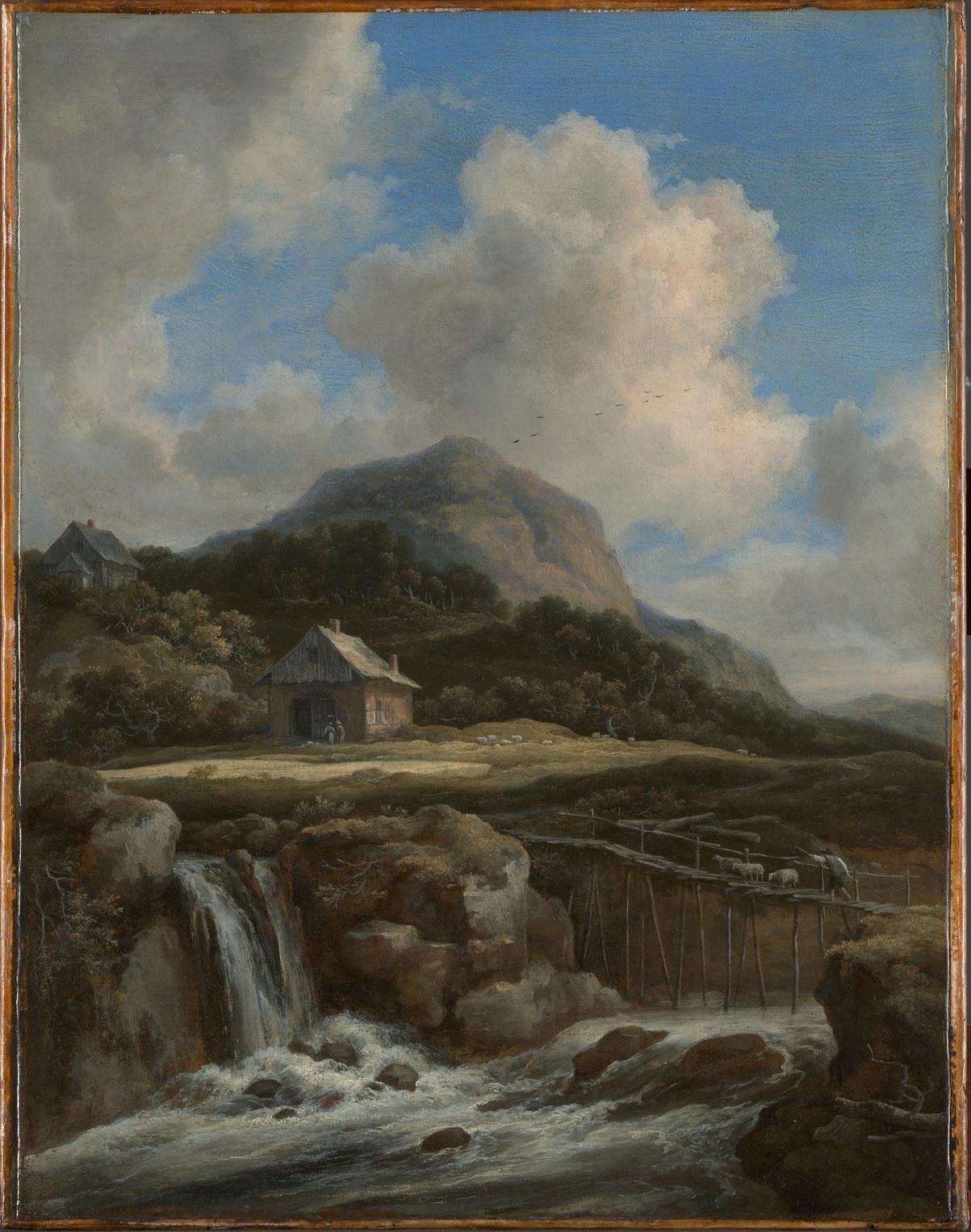
Mountain Torrent
Beneath a tumultuous sky, water crashes over rocks in the lower left of Jacob van Ruisdael’s "Mountain Torrent." The waterfall, depicted in cool white, frothy brushstrokes, immediately seizes the viewer’s attention and injects a sense of restless energy throughout the composition. This drama is intensified by the way the rushing water contrasts with rugged, nearly black boulders that hem in and guide its flow. The impression of spontaneity is carefully constructed, anchoring the painting’s dynamic structure and reinforcing its forceful mood.
Moving upward from the waterfall, a modest wooden structure is visible near the mid-ground on the left. Nestled amid trees and rocks, the cottage appears partially shrouded in shadow, suggesting shelter yet emphasizing its vulnerability. Positioned just off center, the humble dwelling punctuates Ruisdael’s otherwise sweeping landscape, introducing a note of human presence. This presence, modest and exposed, stands in stark contrast to the surrounding landscape’s grandeur and power, creating a narrative tension between precarious shelter and untamed nature.
The scene’s narrative unfolds further with a slender wooden bridge crossing the composition at right. A small group of animals, accompanied by a herdsman, traverses the bridge, their figures lending movement and a pastoral touch to an otherwise dramatic terrain. This fragile crossing physically and metaphorically links the sphere of human habitation with the unpredictable forces below. Ruisdael carefully balances these elements, allowing the bridge to function as an axis—organizing the intersection of human routine and natural tumult.
Above, the sky dominates the upper portion of the painting with voluminous, shifting clouds in muted greys, creams, and whites. These broad passages of light and shadow convey both atmospheric depth and a sense of variance, echoing the energy of the water below while offering a visual counterbalance. Ruisdael’s simulation of moving weather exemplifies a central concern of seventeenth-century Dutch landscape painting: the interplay of land, water, and air as living elements in constant flux.
Through his technique in "Mountain Torrent," Ruisdael demonstrates his mastery of oil painting and his acute attention to texture. The craggy surfaces of rocks and forms of trees are modeled with controlled, refined brushwork, whereas the waterfall and sky are treated more loosely, with broad, gestural strokes. Nuanced transitions in light—reflected on wet stone, glowing in foliage, or gliding across clouds—reveal a skilled awareness of nature’s changing conditions. These effects not only render convincing detail but also evoke the restless atmosphere and perennial movement inherent in the landscape.
Historically, Jacob van Ruisdael stands among the most celebrated landscape painters of the Dutch Golden Age. While the Netherlands is largely flat, Ruisdael’s mountain landscapes and waterfalls, like "Mountain Torrent," are imaginative composites, influenced in part by works of earlier painters such as Allart van Everdingen, who traveled to Scandinavia and introduced these motifs to Dutch art. According to The Metropolitan Museum of Art, this painting exemplifies Ruisdael’s capacity to synthesize elements from nature and artistic precedent into powerful, idealized scenes rather than documenting specific locations.
The relationship between human figures and the grandeur of the landscape exemplifies a signature device in Ruisdael’s work. Objects such as the cottage, bridge, and livestock all serve to establish human scale, but they ultimately are dwarfed by the magnitude and energy of their environment. This compositional hierarchy transforms the landscape into the primary subject, suggesting a meditation on nature’s overwhelming presence in relation to daily human existence.
By closely observing "Mountain Torrent," viewers encounter a nuanced dialogue between the domestic and the elemental. Ruisdael’s intricate arrangement and technical virtuosity transform a view of rushing water and brooding clouds into a thoughtful meditation on humanity’s situation within the larger natural world. The painting remains a testament to the artist’s enduring vision—a work that continues to prompt contemplation of the interconnectedness, beauty, and vulnerability that define both landscape and life.
About the artist
Jacob van Ruisdael (Dutch, Haarlem 1628/29–1682 Amsterdam) was a preeminent landscape painter of the Dutch Golden Age. Renowned for his technical brilliance and creative invention, he shaped the landscape genre through atmospheric effects and expressive compositions. "Mountain Torrent," painted in the 1670s, entered The Metropolitan Museum of Art’s collection through the bequest of Collis P. Huntington in 1900.
A nineteenth-century likeness of Jacob van Ruisdael, made long after the painter’s death. Rijksmuseum, Amsterdam
Read the painting details
Who painted the falls?
The stream breaks into white water as it drops over the rocks. This scene was once attributed to Allart van Everdingen. The Met now gives it to Jacob van Ruisdael, whose landscapes still showed the other painter’s influence late in his career.
A doorstep above the water
The cottage stands on a patch of nearly level ground above the falls. Imagine stepping out of its dark doorway: a few strides of quiet earth separate the threshold from the ledge where the stream pitches over.
How to cross a torrent
The little group has a way across that is easy to miss at first: a narrow timber bridge stretches from one bank to the other. Follow its nearly level line, then look straight down at the drop the crossing spans.
How much sky fits here?
The rounded cloud above the peak towers over the little cottage. This whole seventeenth-century canvas is only 54 centimetres tall: hold your hands that far apart and see how much sky fits between them.